

About J. F. Oberlin Junior
and Senior High School

J. F. Oberlin Junior and Senior High School traces its origins back to Chongzhen Academy, founded in Beijing in 1921 by Yasuzo Shimizu. Since then, the school has continued to uphold its founding spirit: “the cultivation of internationally minded individuals based on Christian principles.”
From its earliest days, students of different cultures and backgrounds learned together in an atmosphere of mutual respect and understanding. This spirit remains at the heart of our education today.
In today’s rapidly changing and increasingly diverse world, we believe students need more than academic knowledge. They need the ability to think deeply, communicate with compassion, collaborate with others, and take action to create a better future.
At our school, students engage in international programs, inquiry-based learning, entrepreneurship education, UNESCO activities, and digital innovation (DX). Through these experiences, they learn to ask questions, take initiative, and create new value for society.
Guided by our school motto, Gakuji Jinin—“Learning in order to serve others”—we encourage students to use their talents not only for themselves, but also for the good of others and for peace in the world.
Together with students, families, and the community, we will continue creating a new vision of education for the future.
Open the door to well-educated and knowledgeable international people based on the Christian spirit
Oberlin Gakuen advocates "cultivation of international people based on the spirit of Christianity" as the founding spirit.
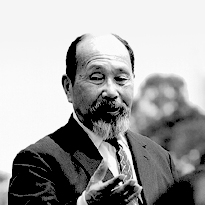
The purpose of the university's founding is to educate as many people
as possible who have mastered both Christianity and language.
Founder Yasuzo Shimizu
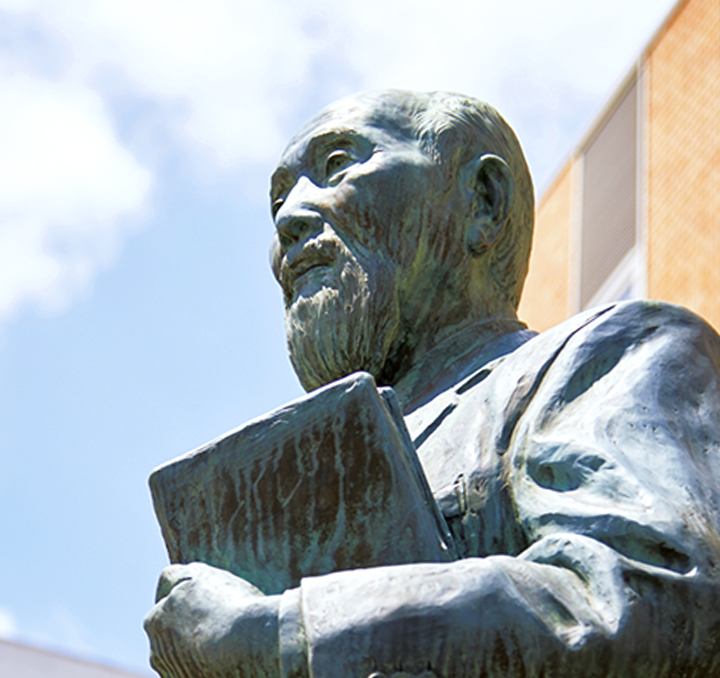
About Yasuzo Shimizu, the founder of the school
As a pioneer of international education and volunteering, the founders of this school, Yasuzo and Ikuko Shimizu, opened a private school in the suburbs of Beijing in 1921 and started educational activities for children suffering from poverty to help them become independent.
After Japan’s defeat in WWII, Yasuzo Shimizu and his wife were forced to withdraw from China, but after returning to Japan, they established Oberlin Gakuen in Machida in the hopes of developing human resources to serve the international community.
Oberlin Gakuen Motto
Learning and Labor
The teaching of "Gakujijin: Use what you have learned for people and society", which Sakurabirin Gakuen still cherishes as the school's motto, is "Learning and" advocated by Jean-Frederick Oberin. It overlaps with the idea of "Labor".
Oberlin Gakuen aims to train international figures through Christian education.
The founder, Yasuzo Shimizu, came into contact with Christianity at a young age and practiced the Christian spirit of "serving God and people and loving his neighbor like himself" throughout his life.
Inheriting the passion of this founder, "based on Christianity, we aim to"cultivate internationally educated people"
About Oberlin Gakuen School Emblem

When Jesus Christ was crucified, he was covered with a crown of thorns. This is what those who are hostile to Jesus Christ put on Jesus as a sign of mockery. The crucifixion at that time was a cruel Roman punishment of striking three nails on both hands and feet.
The school emblem of this school symbolizes the Christian belief that we can be led to the glory of God through the hardships of Christ. Three nails were placed on the crown, and a cross and a circle representing the glory of God were placed on the top.
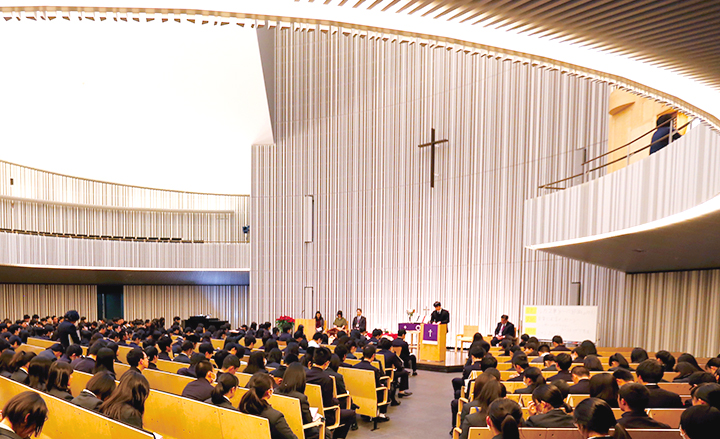

Visualize the size and fun of Oberlin.
Ground area

J. F. Oberlin junior and Senior High School is located in the lush green city of Machida.
Total number of students

Enrollment in junior and Senior High School is shown in the graph below.
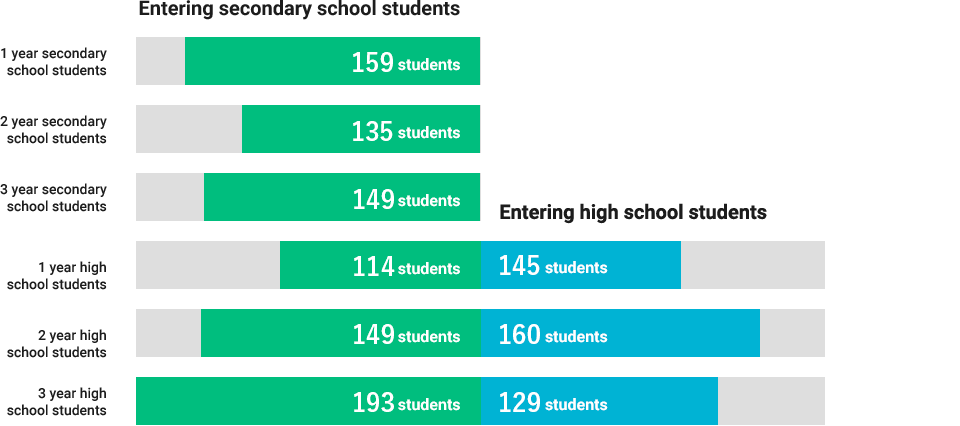
The total number of secondary school students

The total number of high school students

J. F. Oberlin University and Affiliated Schools and Oberlin College in Ohio, U.S.A., are legally independent educational institutions; there is no corporate affiliation between the two, and neither is a subsidiary or agent of the other.